Tools to see what your stack is really costing you.
Four calculators. Real numbers. Zero pitches.
Four tools. Pick one and run the math.
Click any card to start. Everything runs in your browser.
Take the thinking with you.
Drop your email and we'll send the download link straight to your inbox.
The Custom Platform Buyer's Guide
Everything to evaluate custom platform development versus stacking more SaaS. 22 pages, no fluff.
15 SaaS Tools You Can Kill This Quarter
The 15 tools most businesses are overpaying for and what replaces them. 14 pages.
Field notes
Essays on owning your software instead of renting it.
Your Software Stack Is a Liability. Your Platform Is an Asset.
You do not own your software. You rent it. And every month the landlord raises the price.
Read 4 minWork Inside a Bag, Not a Box
SaaS hands you a box and tells you to fold your business to fit. A custom platform is a bag. It takes the shape of whatever you put in it.
Read 4 minWe Have Been Building in AI Since 2017
Everyone discovered AI in late 2022. We had already been building with it for five years. That head start is not a bragging point. It is the difference between knowing what works and guessing.
Read 4 minLaunch in as Little as Two Weeks
Agencies quote six months because their process takes six months. Ours does not. The timeline is not about how hard the work is. It is about how the work is done.
Read 5 minThe SaaS Tax Nobody Adds Up
Run the five-year number on your stack. Not the monthly. The five-year. Then put it next to what a platform costs. The comparison is not close, and the gap is growing.
ReadGlossary
Plain language for the words that get thrown around.
AI Orchestration
The practice of coordinating multiple AI models and tools so they work together as one system instead of as scattered one-off features. Good orchestration routes each task to the right model, tracks cost, handles failures, and keeps a human in the loop where it matters. It is the difference between AI that demos and AI you can run a business on.
API
Application Programming Interface. The doorway one piece of software uses to talk to another. When your tools have good APIs, they can share data. When they do not, you end up copying information by hand or paying for middleware to bridge the gap.
Business OS
A single platform that runs the whole operation: customers, projects, billing, communication, files, and reporting in one place. The opposite of a stack of disconnected tools. SpinFlow builds Business OS platforms so a company runs on one system it owns instead of twelve it rents.
Churn
The rate at which customers leave. In SaaS it is the metric every vendor watches, which tells you something: their business depends on you staying subscribed whether or not the tool still serves you. When you own your platform, churn stops being a force acting on you.
CRM
Customer Relationship Management. The system that holds your leads, contacts, deals, and the history of every interaction. Most businesses rent one and bend their process to fit it. A custom CRM fits your process instead, holding the parts of your sales motion that off-the-shelf tools cannot represent.
Custom Platform
Software built specifically for one business instead of for the average of many. It does exactly what that business needs, integrates natively because it is one system, and is owned outright rather than rented. The asset version of software.
Dependency
Anything your business relies on that you do not control. Every SaaS tool in your stack is a dependency: if its price rises, its terms change, or it shuts down, you absorb the hit. Owning your platform removes the dependency.
Eating Your Own Cooking
Running your own business on the exact product you sell. SpinFlow runs on SpinFlow. Every prospect who logs in to pay an invoice or review work is using the thing we build. If it is not good enough for us, we do not ship it.
Edge Function
A small piece of server-side code that runs close to the user for speed and handles the work that should not happen in a browser, like talking to a payment processor or sending email securely. The plumbing that makes a platform do real work safely.
Glassmorphism
A design style using frosted, semi-transparent layered surfaces to create depth. Used well, it makes an interface feel premium and modern without getting in the way of the work.
Integration
Connecting two systems so they share data. The more separate tools you run, the more integrations you need, and each one is a thing that can break. A single platform needs almost none, because it is already one system talking to itself.
Lead Magnet
A free, valuable resource offered in exchange for contact information. A guide, a calculator, a checklist. The honest version delivers real value first and earns the right to follow up. The dishonest version is bait. The difference is whether the free thing actually helps before anyone asks for the sale.
Lock-in
The state of being trapped in a tool because leaving costs too much, usually because your data is stuck inside it and your processes are wired to it. SaaS pricing and design quietly encourage lock-in. It is the reason businesses keep paying for tools that stopped serving them.
MCP
Model Context Protocol. A standard way for AI assistants to securely connect to and operate the tools and data of a business. With MCP, an AI can read your real data and take real actions through one controlled, authenticated connection instead of a pile of brittle one-off integrations.
Middleware
Software whose only job is to connect other software. Tools like automation platforms that pass data between your disconnected apps. Middleware is a tax you pay because your tools do not talk to each other natively. A single platform makes most of it unnecessary.
Migration
Moving your business off your current tools and onto a new system, including bringing your data along. The fear of migration is what keeps people locked into stacks they have outgrown. Done right, it is a one-time, well-planned move, not the open-ended nightmare people imagine.
MVP
Minimum Viable Product. The smallest version of something that delivers real value, shipped fast so you can learn from real use instead of guessing. The point is to launch, learn, and improve, not to perfect in private for a year.
Owned Software
Software you possess outright rather than license month to month. It is an asset on your side of the ledger, it does not raise its own price, and it can be sold with the business. The opposite of the rental model that defines SaaS.
pgvector
A tool that lets a database store and search information by meaning rather than by exact keyword. It is what powers a knowledge base an AI can actually search intelligently, finding the relevant answer even when the words do not match exactly.
Platform
A single foundation that many capabilities are built on, sharing one database, one login, and one design. Contrast with a stack, which is many separate products loosely tied together. A platform is coherent by design. A stack is coherent only by effort.
RAG
Retrieval Augmented Generation. A method where an AI looks up relevant information from your actual data before answering, so its responses are grounded in your business instead of made up. It is how you get an AI assistant that knows your specifics rather than guessing from general training.
Retainer
An ongoing arrangement where you pay a set amount regularly for continued service, usually maintenance and improvements after a platform launches. The healthy version keeps your platform evolving with your business. It is the difference between software that ages and software that keeps up.
RLS
Row Level Security. A database rule that controls exactly which records each user can see and touch, enforced at the data layer itself rather than trusting the app to behave. It is the foundation of keeping one client's data invisible to another. Non-negotiable on anything holding real business data.
SaaS
Software as a Service. Software you rent monthly instead of own. Convenient to start, easy to pile up, and structured so the cost compounds and the vendor holds the leverage. The default model for business software, and the one SpinFlow exists to replace for companies that have outgrown it.
SaaS Tax
The full cost of running on a stack of rented tools, including the parts nobody adds up: subscriptions, annual price increases, integration maintenance, data friction, workarounds, per-seat scaling, and lock-in. The monthly statement shows a fraction of it. The five-year number is the real one.
Schema
The structure of a database: the tables, the fields, and how they relate. A well-designed schema is the skeleton of a good platform. Get it right and everything built on top is solid. Get it wrong and you fight it forever.
Stack
The collection of separate software tools a business runs to operate. The more it grows, the more it costs, the more it breaks at the seams between tools, and the less any single tool can see the whole picture. The thing SpinFlow replaces with one owned platform.
Vertical Slice
Building one complete feature end to end, from the database to the interface, before starting the next, instead of building all the back end first or all the front end first. It means every step produces something that actually works, so you are never far from a usable result.
Webhook
An automatic message one system sends another the moment something happens, like a payment clearing or a form being submitted. It is how systems react to events in real time instead of constantly checking whether something changed. The nerves of a connected platform.
Workaround
The manual process someone invents to cover the gap where a tool almost does what is needed but not quite. Every workaround is a small permanent tax on time and a source of errors. A pile of workarounds is the clearest sign your software does not fit your business.
From the blog
Recent thinking.
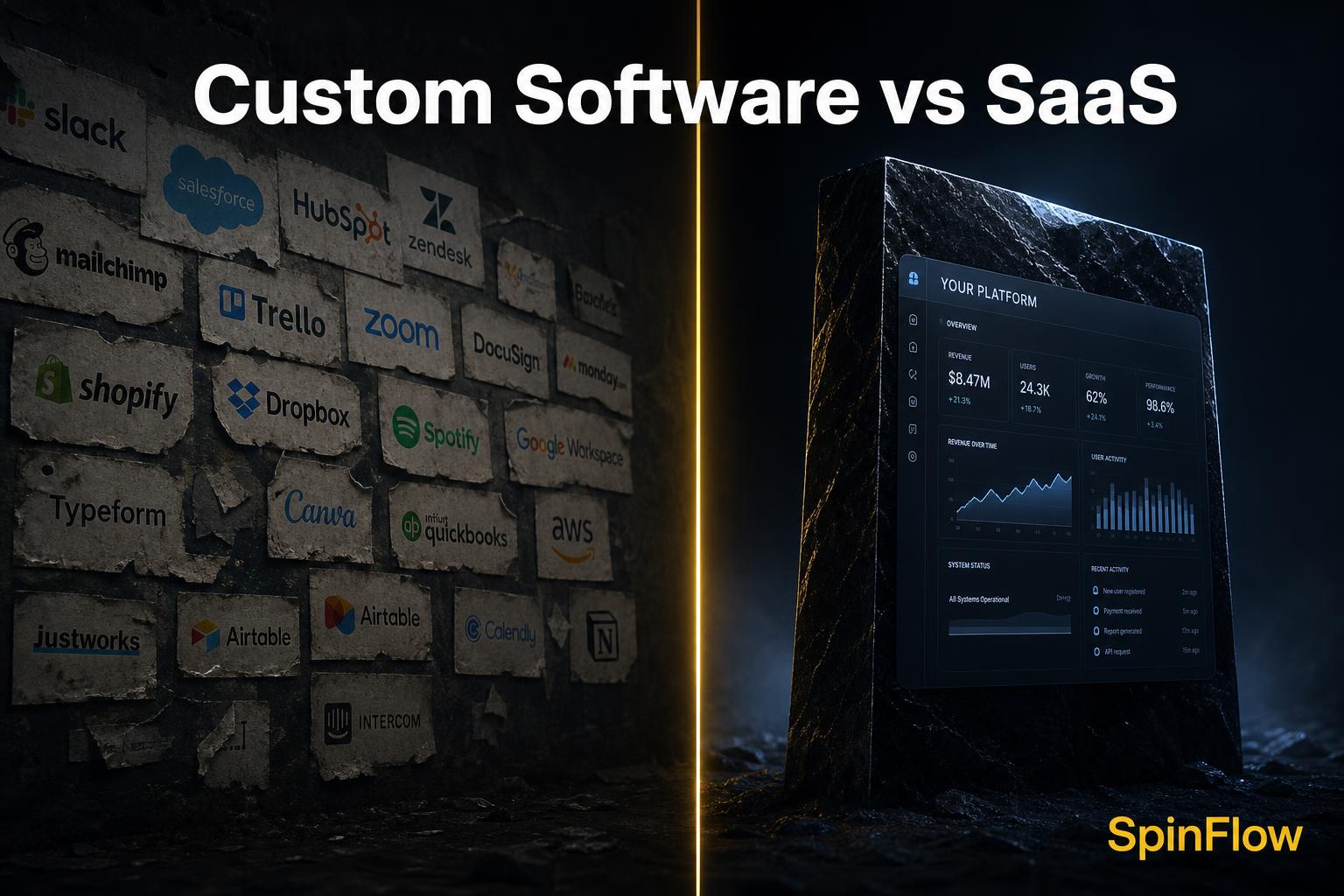
Custom Business Software vs SaaS: When to Stop Renting and Start Owning
When custom business software beats SaaS, how the math works, and why AI agents make owning your platform more valuable than renting one.
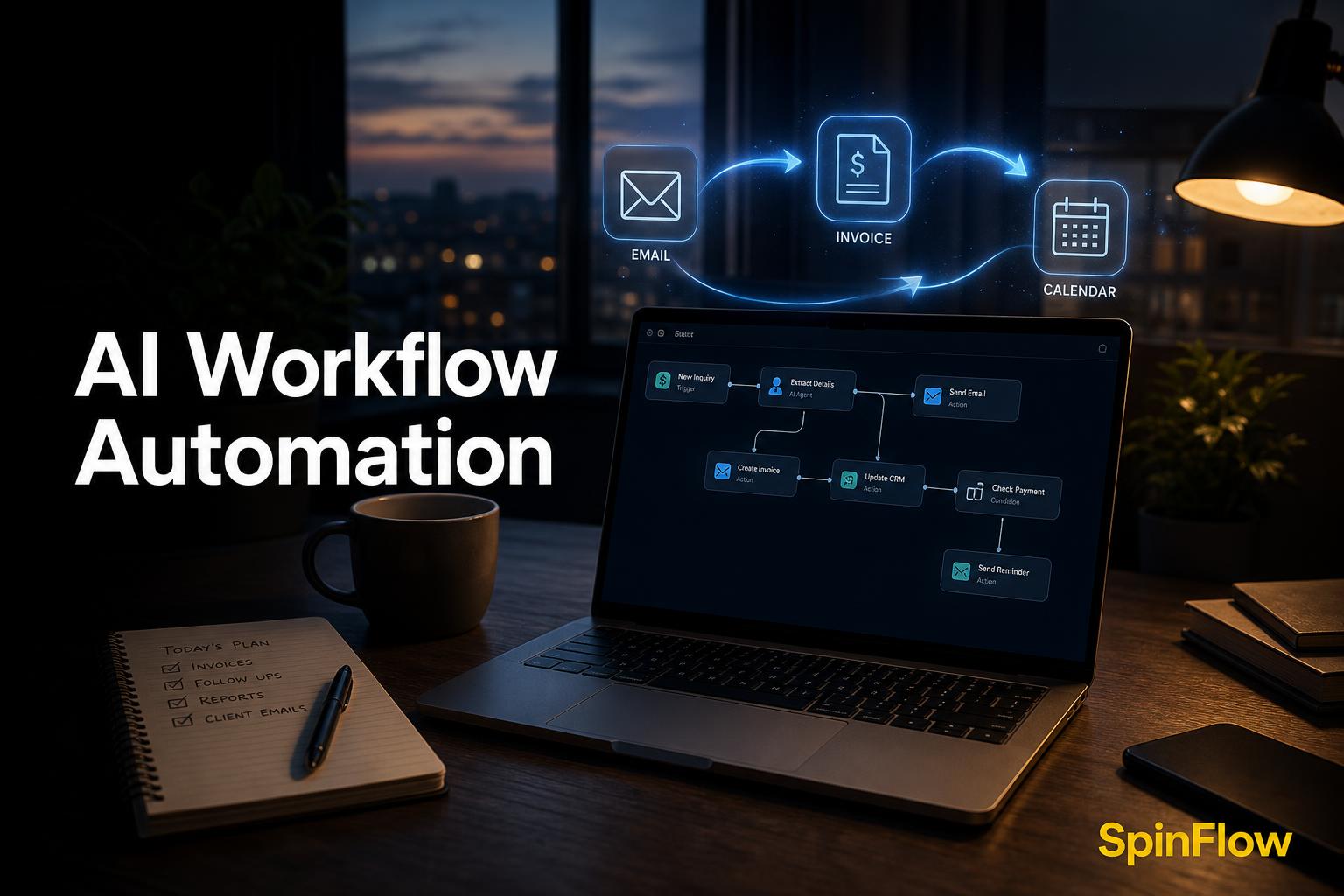
AI Workflow Automation for Small Business: A Practical Playbook for 2026
A plain English playbook for using AI workflow automation in a small business, with agentic workflows that actually save hours instead of adding tools.
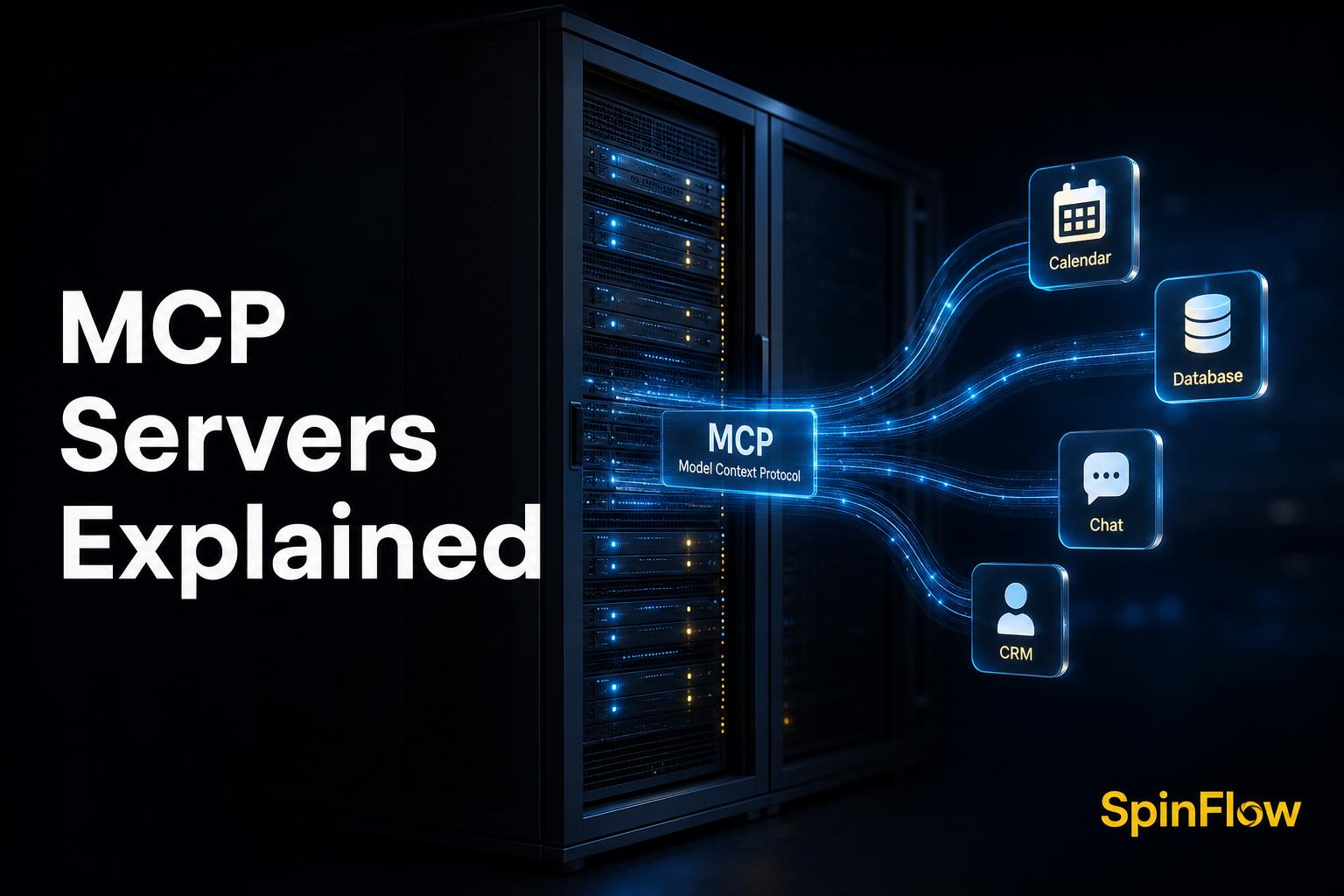
MCP Servers Explained: How Model Context Protocol Turns AI Into a Real Business Tool
What MCP servers actually are, why the model context protocol matters, and how to use it to give your AI real access to your business data and tools.
Numbers told you the story. Now let's build the answer.
30-minute discovery meeting. We'll walk your stack, identify what to consolidate, and quote the build.
Book a Discovery Meeting