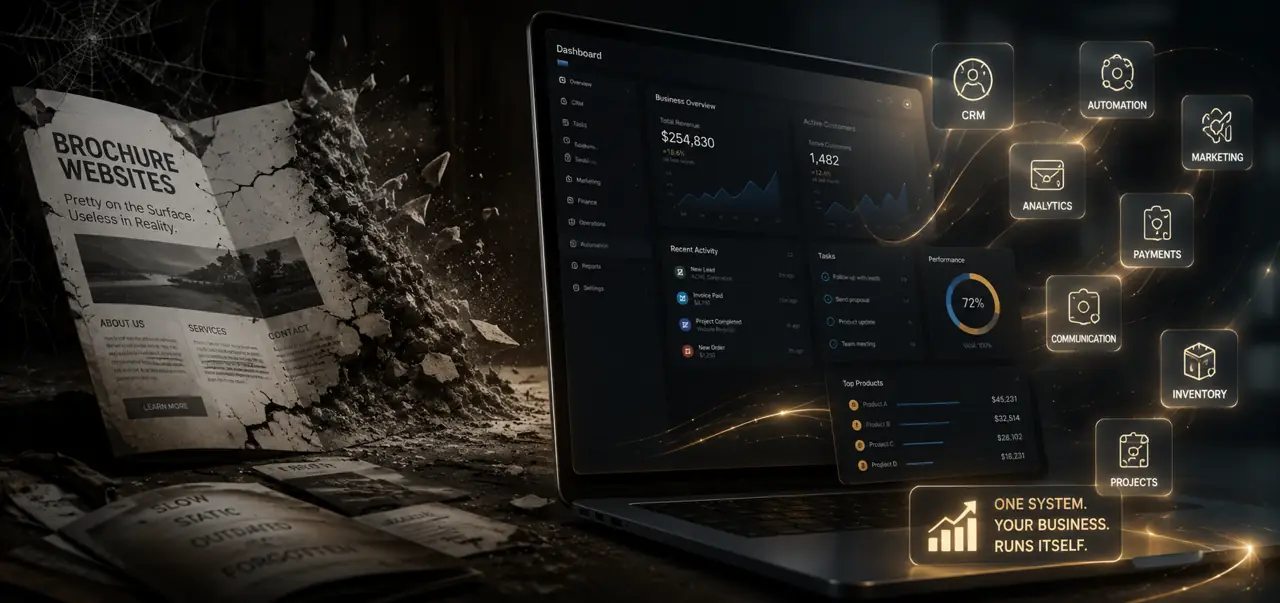
For two decades the goal of a business website was simple: look credible, list your services, and give people a phone number. That was enough when the website was a digital business card. It is not enough anymore.
Today the gap between a site that describes a business and a platform that runs one is the difference between standing still and compounding. Your customers expect to book, pay, track, and self-serve without sending an email and waiting a day for a reply.
The average small business uses 12 to 15 disconnected tools. Each one solved a problem. Together they created a bigger one.
The Era of the Digital Brochure Is Over
A static website is a dead end. A visitor reads it, forms an impression, and then leaves to do the actual work somewhere else - in your inbox, on the phone, or worse, on a competitor's platform that lets them act immediately.
Every interaction that happens off your site is data you never capture and friction your customer remembers.
Why Static Sites Cannot Keep Up
Customer expectations were reset by the platforms they use every day. They expect the same immediacy from a local services business that they get from their bank or their favorite store.
Meanwhile the cost of meeting that expectation has collapsed. What once required a six-figure custom build is now achievable in weeks.
- Customers act in the moment instead of leaving
- One source of truth for every interaction
- No more copying data between tools
- A site that converts instead of just informing
The Platform-First Alternative
The alternative is not a flashier brochure. It is a platform that looks like a premium website on the surface and operates as a complete business system underneath - bookings, portals, invoicing, and CRM sharing one set of data.
Visitors still see a clean, fast, beautiful site. The difference is that every button actually does something for your business.
See what SpinFlow can build for your business.
Book a Discovery CallWhat Businesses See After the Switch
Companies that move from a static site to a platform consistently report fewer manual handoffs, faster response times, and a measurable lift in conversion because customers can act in the moment.
The website stops being a cost center and starts being the engine the business runs on.
How to Make the Transition
You do not need to rebuild everything at once. Start by identifying the one workflow that drains the most time - usually intake, booking, or invoicing - and bring it onto your site first.
From there, each capability you add compounds, because it shares the same data and the same login as the last.